


Weeknights
The fridge is where good intentions go to die
Households are already wasting less food, and the habits that help are small ones: a use-it-first shelf, a ten-minute fridge check and one clean-out dinner a week.
It's Sunday night, and the bag of spinach in the crisper drawer has quietly turned into a liquid. Next to it sits half a lemon, cut side down and gone leathery, and a container of something you cooked on Tuesday that nobody remembers cooking.
You bought every one of those things with a plan. The spinach was going to be smoothies. The lemon was going to be a salad dressing. The Tuesday thing was going to be lunch, twice. The fridge is where those plans go to wait, and then to quietly expire while you order a pizza.
This isn't a lecture about the planet. It's a short guide to the few habits that actually keep food out of the trash, from someone whose crisper drawer has also seen things.
The good news nobody leads with
Most articles about food waste open with a frightening number. Here's a better one.
In April 2026, ReFED, the nonprofit that tracks food waste across the US, reported that residential food waste fell by nearly 950,000 tons in 2024. That's a drop of a little more than 3.7% per person, and households led the national decline. Not farms, not restaurants, not supermarkets. Kitchens like yours.
ReFED's Dana Gunders tied it to grocery prices: "Using up more of what they're already purchasing and wasting less is proving to be one of the most accessible ways to do it."
That's the whole idea of this piece. You don't need a new fridge, a composting system or a spreadsheet. You need to eat the food you already paid for, a bit more often than you do now.
Where the food actually goes
Food rarely gets thrown out for one dramatic reason. It leaks out through four small ones.
- You bought too much. The family pack of chicken was cheaper per pound. The peppers came three to a bag and you needed one.
- You forgot it was there. The back of the fridge is basically witness protection. Things go in and are never seen again.
- The date scared you. A yogurt hits the date on the lid, and it goes in the trash unopened.
- Nobody wanted the leftovers. The lasagna was great on Monday. By Thursday it's an obligation.
Forgetting is the big one. In a survey commissioned by HelloFresh and run by Wakefield Research in June 2025, 76% of US adults admitted to tossing out food. Of those, 42% said it was because they let things expire, and 31% said they just don't like leftovers.
Notice that none of these are about cooking skill. They're about attention. So the fixes are about attention too.
What the date on the label actually means
The date on the package is the most misunderstood number in the kitchen. Here's what the USDA's Food Safety and Inspection Service says about food product dating:
- Except for infant formula, product dating isn't required by federal regulations.
- "Best if Used By" is about flavor and quality. It isn't a purchase date or a safety date.
- "Sell-By" tells the store how long to display the product. It isn't a safety date either.
- "Use-By" is the last date recommended for using the product at peak quality. FSIS says it isn't a safety date, except on infant formula.
FSIS also says that if the date passes while the food is in your kitchen, it should still be safe and wholesome if it's been handled properly, until spoilage is evident. Spoiled food develops an off smell, flavor or texture, and then it goes, whatever the label says.
The labels themselves are slowly getting clearer. California's law requiring standard wording took effect on July 1, 2026: "BEST if Used by" for quality and "USE by" for safety, with "sell by" no longer allowed on foods made after that date for sale in the state. In June 2026, New York's legislature passed a similar bill, and as of October 2026 it was waiting for the governor's signature, as the National Law Review reported. A federal version, the Food Date Labeling Act, was introduced in the House in August 2025 and referred to committee. As of October 2026, it hadn't passed. So for most of us, the label still needs translating.
The use-it-first shelf
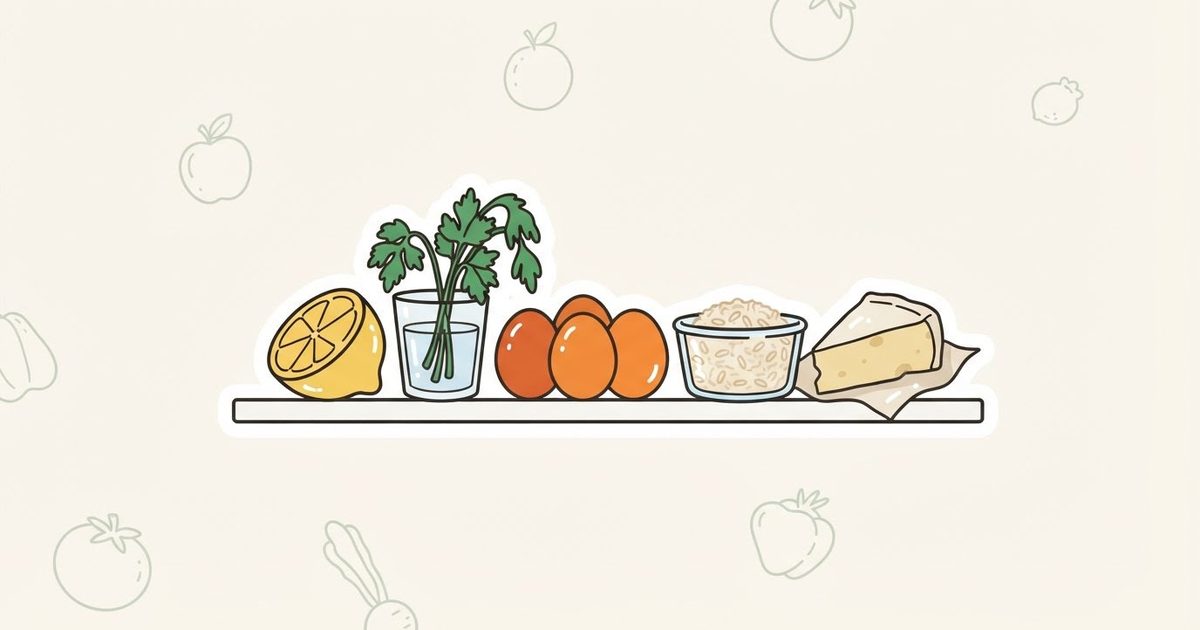
Here's the single habit that does the most work. Pick one shelf in your fridge, at eye level, and make it the use-it-first shelf.
Anything that needs eating in the next few days goes there:
- the half onion and the half lemon
- the open tub of ricotta you bought for one recipe
- last night's leftovers
- the vegetables that are starting to look tired
That's the whole system. It works because it beats forgetting. The food you need to eat is the first thing you see when you open the door looking for a snack. Everyone in the house can learn it in one sentence: "Eat from this shelf first."
A clear bin or a small tray makes it even easier, because you can pull the whole thing out and look at it while you decide what's for dinner. Some people use a strip of masking tape on the shelf edge. You don't need anything that organized. You just need the shelf.
The ten-minute fridge check before you shop
Before you write a shopping list, spend ten minutes with the fridge door open. It feels like a chore for about a week, and then it feels like finding money.
- Pull out the use-it-first shelf. What has to be eaten in the next two days?
- Open the crisper drawers. This is where vegetables go to be forgotten. Rescue anything that's soft but fine, and move it up to the shelf.
- Check the back of each shelf. The jar of pesto. The other half of the coconut milk.
- Pick three things that need using. Write them at the top of your list.
- Plan two dinners around those three things before you add anything else.
While the door's open, glance at the thermometer. FSIS says a refrigerator set at 40 °F (4 °C) or below will protect most foods. A fridge that runs warm makes everything go off faster, and no system can fix that.
Shop your kitchen first
Once you've done the check, the shopping list almost writes itself. You're filling gaps, not buying a new week of food from scratch.
A few rules help:
- Buy for meals, not for vibes. The bunch of kale you'll "definitely eat this week" is a classic. Buy it when it's in an actual dinner.
- Plan fewer nights than you think. Four planned dinners and three loose ones leaves room for leftovers, a night out, and the evening when nobody can face cooking. If deciding is the hard part, what's for dinner gets easier with a short rotation.
- Use the freezer as a pause button. Bread, cooked rice, grated ginger, the last of a pot of soup. Freezing stops the clock. FSIS notes that frozen food stays safe indefinitely and that freezer times are about quality. It won't taste as good after a long time, but it won't hurt you.
This is also where big holidays go wrong. A feast for six cooked from a recipe built for ten is how you end up eating turkey until December. If that's your house, a small Thanksgiving is worth planning on purpose.
Clean-out dinners
Once a week, make dinner out of whatever's on the use-it-first shelf. Not a recipe, a format. These four take almost anything.
- Fried rice. Day-old rice, any vegetables, an egg or two, soy sauce. Leftover chicken or pork gets chopped small and thrown in at the end. Cold rice works better than fresh, so leftovers are the point.
- Frittata. Eggs, a splash of milk, and every sad vegetable and cheese end you own. Soft herbs go on top. It's good warm, and it's good cold the next day.
- Soup. An onion, whatever vegetables are fading, stock or water, and a can of beans or a handful of pasta. Blend it if the vegetables look rough. Nobody can tell.
- Grain bowl. A base of rice, farro or noodles, then leftover roast vegetables, a protein, something crunchy, and a sauce. A spoonful of yogurt, a fried egg or a squeeze of that half lemon pulls it together.
The trick with leftovers nobody wants is to change them, not just reheat them. Monday's roast chicken becomes Wednesday's fried rice. Last night's roasted vegetables go into the frittata. Same food, new dinner, no groaning. If you want a fuller method for this, there's one in cook with what you have.
One food-safety note. When you're done cooking, get leftovers into the fridge promptly. FSIS says perishable food shouldn't sit out more than 2 hours, or 1 hour if it's above 90 °F (32 °C). Shallow containers cool faster.
Do this tonight
Open the fridge. Pick a shelf at eye level and clear it. Go through the drawers and the back corners, and move three things that need eating onto that shelf. Then make dinner from one of them, even if it's just eggs with whatever's wilting.
Tomorrow, tell everyone in the house the one rule: eat from this shelf first.